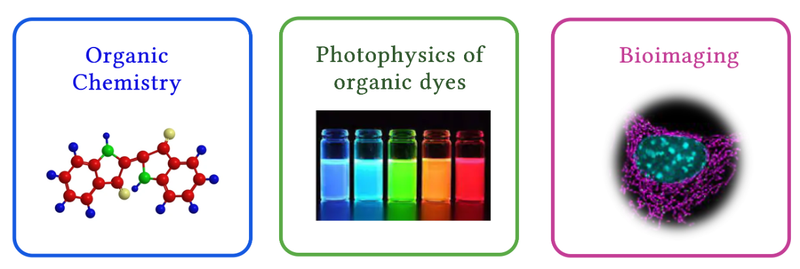
Our research is centered on the molecular design and synthesis of innovative chemical tools, particularly small-molecule fluorescent probes, for functional imaging and modulation of biological systems. We integrate principles of synthetic organic chemistry, photophysics, and supramolecular chemistry to develop responsive probes with high spatial and temporal precision. Using these chemical platforms, we seek to interrogate complex biological processes and disease mechanisms at the molecular level, with a particular emphasis on neurological disorders. Through an interdisciplinary approach, our work aims to advance chemical biology while bridging fundamental chemistry with translational applications in healthcare.
Our interests span:
- Design and synthesis of small-molecule fluorescent probes for precise targeting and imaging of subcellular organelles.
- Development of quantitative imaging tools to monitor ion dynamics, neurotransmitters, and enzyme activities within organelles, enabling deeper insights into organelle-specific biochemistry.
- Application of chemical probes in disease models, particularly neurodegenerative disorders, to elucidate the role of organelle dysfunction in disease onset and progression.
- Engineering light-responsive (photoactivatable) chemical systems to modulate organelle microenvironments, facilitating spatiotemporal control of cellular processes and exploring their therapeutic potential.
Our research will commence with the the rational design and synthesis of small molecule based fluorescent probes, followed by their characterization using various spectroscopic techniques. We will then explore these probes in both cell lines and primary cells, and conduct functional imaging with high-resolution fluorescence microscopy.